Showing posts with label Traditional Marketing. Show all posts

Tuesday, November 12, 2013

A Quick Look at O.C.D. Experience

O.C.D. Experience was founded by Justin Klosky in 2008. From a young age, Klosky suffered from obsessive compulsive disorder. After taking up acting for a few years, Justin decided to go the entrepreneurial route. By creating O.C.D. Experience, Klosky wanted a way to channel his disorder and use it to teach others the benefits of not only having an organized home, but an organized life.

Justin Klosky, founder of O.C.D. Experience
The acronym O.C.D. in O.C.D. Experience stands for Organize & Create Discipline. It’s a way for people to change their lives through organization. The company currently offers in-home and virtual consulting services. Consultants go into customers’ homes and organize the problem area. Additionally, they also offer virtual consultations for customers who are outside their three main service areas of California, Florida, and New York.  In addition to the consulting, Justin and O.C.D. Experience are publishing a book that is set to release in late 2013. They also sell a wallet and offer a smartphone app geared towards parents. Finally, Justin makes numerous local and national television appearances to promote the brand.


The target audience of O.C.D. Experience is primarily women. I would put their age anywhere between early 20’s to late 50’s. The idea is geared towards women who manage and organize the household. I would expect both parents and those without children to find value in the services. At the end of the day, everyone lives in some type of space that requires some type of organization. So the product may have appeal to the masses.

Back in 2010, a Forbes article stated, “The industry is evolving, and anyone who wants to keep pace has no choice but to reach across traditional boundaries and start tearing down silos.” O.C.D. Experience should adopt an integrated marketing campaign (I.M.C.) to streamline their marketing efforts, maximize their reach, and differentiate themselves from competitors. It’s no secret that Justin has a great energy and presence. By creating a consistent brand voice and projecting Justin’s personality across all of the marketing channels, I believe the O.C.D. Experience can reach new levels. A few top strategies include:

·      Promoting Justin Klosky as the face of the brand
·      Actively pushing release of the upcoming book
·      Introducing more consumer and search friendly blog posts and videos
·      Revamping the social media content
·      Introducing new marketing channels to maximize brand exposure

The company will be able to reach a larger audience, increase website traffic, boost sales, and become the leading organization company.

Sunday, September 15, 2013

Google Marketing 101

Google is a great company and expert marketer. They put a lot of time and effort into their products and it shows.

Google has made their mark on the Internet through their advertising service, Google AdWords. While AdWords is responsible for a majority of the push marketing we see online from other businesses, Google themselves uses this technology to advertise both their physical and digital products. Below are two banner ads that Google has used to tout Google Drive and magazines available on Android. Additionally, Google also uses television commercials and magazine ads among many others.


Google has reached a level of pull marketing that few companies are able to achieve. Whenever a business becomes a verb, you know they’ve done well. Word-of-mouth marketing plays a large role in Google’s success. Nearly everyday someone I interact with (or myself) says, “I don’t know. Let me Google it.” When someone says “Google it,” you don’t go to Yahoo! or Bing, you go to Google. This language is a strong pull marketing technique. Additionally, Google services are often bragged or touted about by their consumers. Google puts a lot of time and effort into perfecting their products and the customer satisfaction proves the success. I have started using many of their services, like Android, Google Drive, or Gmail, simply because I have trusted friends who use the services as well.

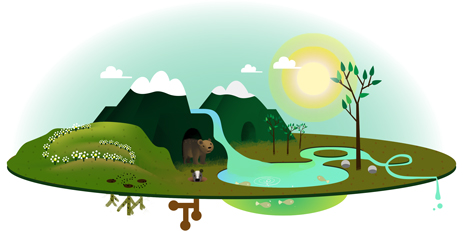
Google keeps content fresh right a number of different ways. On their homepage, Google often updates their logo with a Google Doodle. Google redesigns their logo for holidays, historical anniversaries, and a few obscure days as well. Usually when there is a new Google Doodle, the term “Google Doodle” is trending on Twitter. It’s a fun and successful marketing technique that brings traffic to their website. When you click the image, it automatically searches the occasion it is celebrating. This a great way to encourage searches and learn something new. In addition to the Doodles, Google keeps content fresh on a company blog and, of course, Google+.

Google Doodle on Earth Day 2013


Part of what makes Google so great is a seamless experience from desktop to mobile devices. Google has been a large pioneer in mobile technology. From searching to maps, Google does a great job with their mobile websites. For a more specialized experience, Google offers smartphone apps for their more popular services like Google Drive and Google Maps. The company knows the future is in mobile technology and they are actively developing the medium.

Google has deep integration with their social platform Google+. The company takes it a step further and uses these social features to help improve their product. By gauging interactions with +1’s and link shares on Google+, Google is improving their search results. By keeping people within the Google environment they are successfully improving their own products. It’s a genius cycle that works well for them; however, ignoring Facebook and Twitter integration could cause them to miss out on additional social sharing.

Google’s website has many features that most people do not know about. For example, most people don’t realize that Google actually has a store on their website where they sell their more popular devices. The offerings are limited, but they never really advertise this store unless you come through ad advertisement. Recently, Google used their homepage to advertise their newest tablet, the Nexus 7. When your website is gettinga majority of the traffic online, this a great space to utilize and it’s a wonder they don’t do it more often. Google should try to make an effort to make more consumers aware of the unknown sections of their website.

While Google is king of search engines, a few of their competitors have unique features that make them more appealing. For example, Bing has deep integration with photos. Whenever you go to their home page, there is a huge and enticing picture. Additionally, along the bottom of the screen there is a bar that shows what stories are trending online. It’s a great way to keep consumers informed and encourage searching. There are many things Google could do to their homepage to create a richer experience. Because a majority of users are logged in when searching, why not include some personalized features on the home screen like weather or a Google+ feed. Even though Google may be going for a minimalist approach of their homepage, I think they could do more to create a richer experience.


Bing.com


What do you think of Google’s marketing? Where do they excel and where could they use improvement?

Monday, September 2, 2013

How Social Media Has Changed the Availability and Scope of a Marketer

Social media has changed the marketing landscape in a number of different ways. A recent infographic examined these changes. Below are a few thoughts on two of the changes: Availability and Scope.


Availability

Customer service hours of 9 a.m. to 5 p.m. are a thing of the past. Social media is on 24 hours a day, 7 days a week. Customers no longer have to wait until the next day to contact someone for help. They can complain at 6 a.m. or 10 p.m. Furthermore, customers expect an answer and expect one fast. A 2012 study by Edison Research found that 42% of social media users expect a response within 60 minutes of their complaint, regardless of the time of day. 10 years ago, this scenario would have been a nightmare; however, smartphones have allowed marketers to be on the clock all day, everyday. I have received Facebook notifications on my phone from an upset customer during lunch, on a Saturday, and while on vacation. It is part of the job I have come to accept. Previously, customer service ended when you left the office, now it is on all the time. It’s vital for businesses to have the policies and procedures established to readily respond to customers whether it’s during normal business hours or outside.


Scope

The Internet and social media have changed the scope of marketing. Businesses can easily target users close or abroad. A local boutique in New York could have a huge social media following in Nevada. Each customer is able to see the same content at the same time. Marketers can still work around geographic boundaries with geo-targeting, but what is written online is written in ink. If you need proof, simply do a search on Google. Christopher Null recently created a list of 9 prime examples. The marketing scope is also directly related to how fast things can spread. One slip could be like a wildfire. Just last week, Klout made a conversational tweet about Dr. Martin Luther King Junior. The tweet spread quickly and within an hour, Buzzfeed had an article titled, “Is This The Worst Tweet in History?

Yikes.

10 years ago, businesses could make a mistake and do quick damage control. Today, it isn’t possible. The scope and speed of social media has created a new type of transparency. It allows customers to see past the corporate facade and businesses to act more honestly and responsibly.


I haven’t been in the marketing industry for very long. For me, this “new” social media marketing is normal. Hearing how social media changed the industry gets me excited for the new and unseen changes to come.